
Showing posts with label folio. Show all posts
Showing posts with label folio. Show all posts
Breaking Shakespeare
In my line of book history work, I have spent a significant amount of time thinking and writing about Shakespeare folios, so I'll refrain from saying anything more than that the image below should be extremely (even frustratingly) familiar:

Monumental Shakespeare
All good Shakespeareans must occasionally make a pilgrimage to Stratford-upon-Avon, and this past summer it was once again my turn to visit Shakespeare's native town. (For more on his relationship to Stratford, see my last post on Shakespeare's printer). I was there to attend a conference held at the Shakespeare Institute where I delivered a paper that traced some of the connections between the epitaph on Shakespeare's gravestone in Holy Trinity -- it takes the form of a malediction, cursing those who would disturb his bones -- and the First Folio. Since I have a rather vexed relationship with the Folio -- see the series of "Breaking Shakespeare" posts listed here -- you would rightly infer that I am a vehement proponent for disturbing his bones (metaphorically, at least).
The First Folio was designed, in part, as a monument and a memorial to Shakespeare. And once I had returned to London, the first order of business was to search out a curious monument that memorializes the First Folio and its compilers, John Heminge and Henry Condell (members of Shakespeare's theatre company). I was fortunate to be joined by Mercurius Politicus (@mercpol) and Wynken de Worde (@wynkenhimself) on this excursion -- which turned out to be just one part of a trans-atlantic, trans-continental set of pilgrimages that I took, in order to tell the full story of this monument.
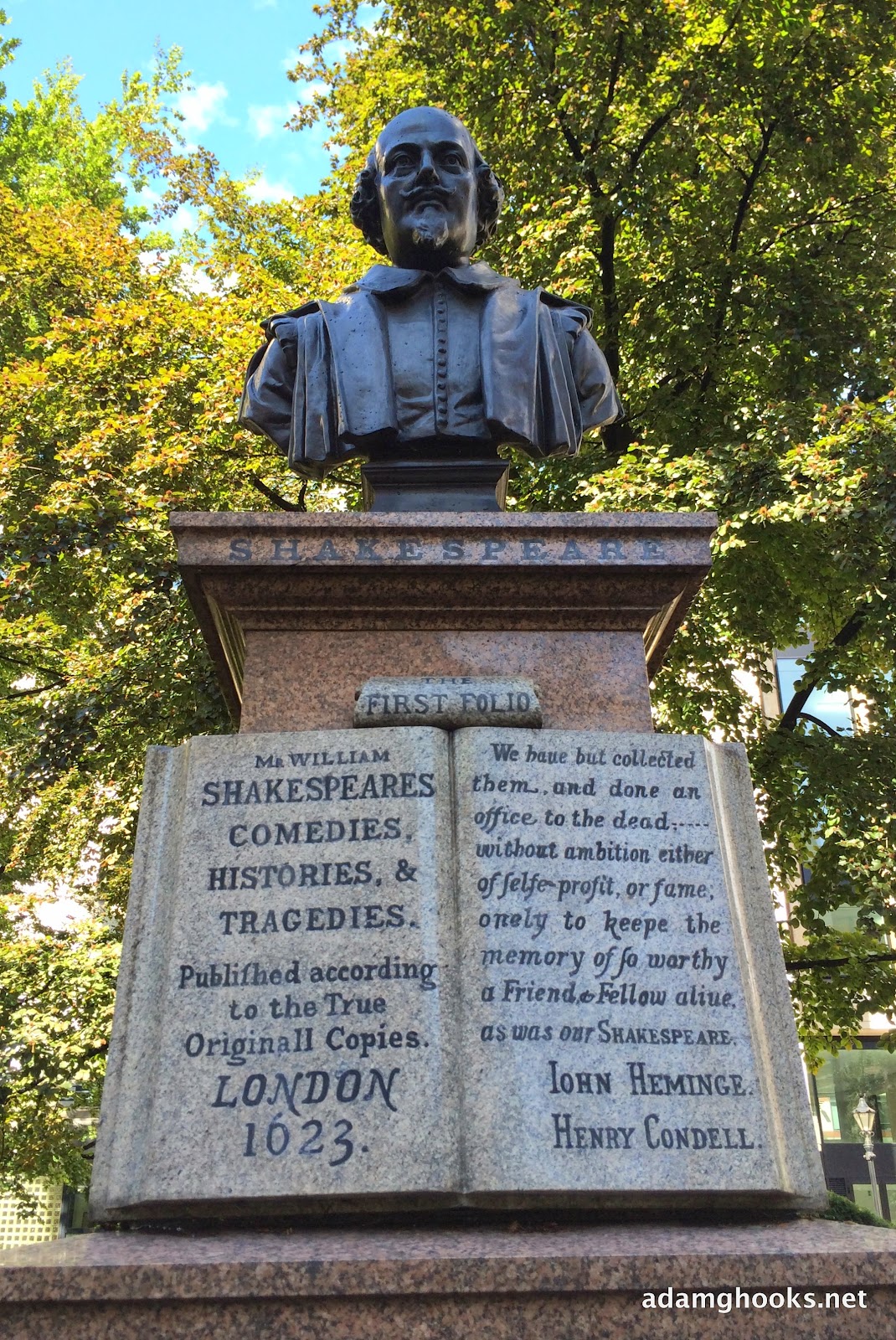
The First Folio was designed, in part, as a monument and a memorial to Shakespeare. And once I had returned to London, the first order of business was to search out a curious monument that memorializes the First Folio and its compilers, John Heminge and Henry Condell (members of Shakespeare's theatre company). I was fortunate to be joined by Mercurius Politicus (@mercpol) and Wynken de Worde (@wynkenhimself) on this excursion -- which turned out to be just one part of a trans-atlantic, trans-continental set of pilgrimages that I took, in order to tell the full story of this monument.
Shakespeare for Sale
I am very pleased to announce the publication of "Shakespeare for Sale" -- a special double issue of Philological Quarterly that features some of the best new work in the field of Shakespeare and book history. Of course, I edited this collection (which started as a seminar I led at the Shakespeare Association of America in 2011) so I don't exactly possess an unbiased opinion -- so you should seek it out for yourself! Fortunately, you can read my introduction along with the table of contents at one of the links just below -- and for more information on Philological Quarterly (which is edited here in the Department of English at the University of Iowa) go here. If your institution subscribes to Literature Online, the issue will also soon be available there, as well.
You can download my introduction either at my Academia.edu page or through this direct Dropbox link. You can also download the entire issue here.

You can download my introduction either at my Academia.edu page or through this direct Dropbox link. You can also download the entire issue here.

Breaking Shakespeare Apart (Part 2)
N.B.: This is part of a series on "breaking apart" the cherished books of canonical authors, so you may want to revisit the earlier posts in the series: Breaking Shakespeare, Breaking Shakespeare Apart, and Breaking Jonson Apart.
As I discussed at length in the previous posts linked to above, the Shakespeare Second Folio is one of the highlights in our Special Collections library here at Iowa, and indeed in some ways it symbolizes the presence and importance of Shakespeare on campus (as you can see in this photo and article featuring our renowned Shakespeare-in-performance expert Miriam Gilbert, who is shown holding it). The library doesn't own a copy of the coveted First Folio, let alone a copy of all four seventeenth-century editions of the folio (as some libraries do, a fact which they inevitably advertise and exploit) -- but as it turns out, we do own a piece of all four folios, as I recently (and accidentally) discovered.

As I discussed at length in the previous posts linked to above, the Shakespeare Second Folio is one of the highlights in our Special Collections library here at Iowa, and indeed in some ways it symbolizes the presence and importance of Shakespeare on campus (as you can see in this photo and article featuring our renowned Shakespeare-in-performance expert Miriam Gilbert, who is shown holding it). The library doesn't own a copy of the coveted First Folio, let alone a copy of all four seventeenth-century editions of the folio (as some libraries do, a fact which they inevitably advertise and exploit) -- but as it turns out, we do own a piece of all four folios, as I recently (and accidentally) discovered.

Breaking Jonson Apart
In my last post (Breaking Shakespeare Apart) I showed how one of the most important and monumental literary books in the world--the Shakespeare first folio--is anything but monumental, and is, indeed, perhaps not even a book. Rather than a definitive and complete whole, it is better thought of as a collection of removable parts--both within the printing house, where the contingencies of business impacted its contents, and in its subsequent life, where copies have suffered the vagaries of time (and of owners keen to sell off their copy bit by bit). In this post I want to look at the book that is often seen as the crucial model for the Shakespeare folio--Ben Jonson's Workes (first published in 1616), a book that is quite literally Jonson's own monument to himself. However, even though Jonson presents his book as a definitive, whole object--the embodiment of (his idea of) his complete works--it, too, is easily broken apart.


Breaking Shakespeare Apart
Remember when my students broke Shakespeare? If you recall, during a class session in special collections, my students broke off the front board of the binding of our most important Shakespeare book, a copy of the Second Folio (1632), a moment which I reveled in, since it allowed me to teach a few valuable lessons about the Shakespeare folio--which is commonly called the most important book ever in the history of the English language ever and even the most important book ever in the whole entire history of the world ever. (Except maybe the bible; and I'm not exaggerating as much as you might think). That moment of minor vandalism took the folio down a few notches, at least for my students, for a few reasons: 1) it's not even a copy of the First Folio, it's "just" a Second Folio; 2) part of the preliminary matter, including the title-page, are later facsimiles inserted to make up a complete copy; and 3) it showed, with great immediacy, that a folio--any Shakespeare folio, and by extension any important symbol of literary or cultural value--is a material object made up of many different physical elements, a fact which calls into question not only its status as a literary icon, but as an actual bounded and complete book. That is, it asks two central questions: what is (our idea of) Shakespeare? And what, exactly, is a book?
 |
| This page is a sacrilegious facsimile! |
Subscribe to:
Posts (Atom)